Politics from First-Principles
There are many Big Ideas that define the way societies have been structured across the generations. Each Big Idea comes with its own benefits and drawbacks. To properly evaluate the value of each system, we need to 1) compare it to other systems and 2) measure the trade-offs.
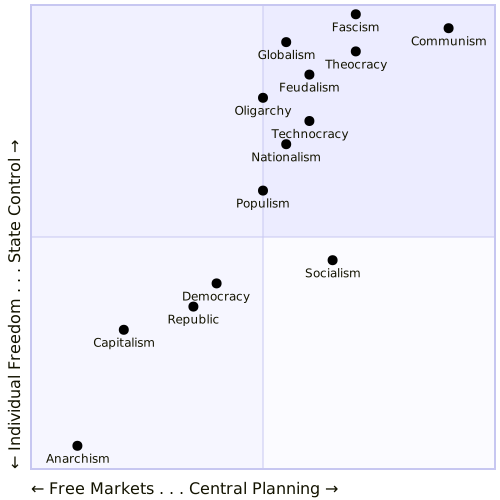
Let’s have a first-principles look at the different systems of governance and how they solve practical problems. We’ll go through a collection of scenarios and thought experiments to get a grasp on the merits of each.
We’ll ask:
- What’s the Big Idea?
- How are societal decisions made?
- Who will build the roads?
- Who will educate the children?
- Who will take care of grandma?
- What will I do day-to-day in this system?
- How are unwanted actions discouraged?
- How has this system functioned in history?
- Does this principle work at the personal level?
We’ll focus on four systems that represent the extremes of the chart above: Fascism, Communism, Democracy, and Anarchism. Each starts from a different core belief about how people should live together.
Fascism: Total Unity
The nation’s strength and glory transcend individual rights.
This emerges from the belief that liberal democracy and individualism make societies weak, divided, and decadent. A strong nation requires total unity under a powerful leader who embodies the national will. The state must control all aspects of life to mobilize the nation toward greatness, rejecting both the chaos of freedom and the weakness of equality. Only through disciplined hierarchy, militant nationalism, and the suppression of internal enemies can a people achieve their destiny.

Communism: A Controlled World
Human suffering and inequality are products of systems, not nature.
This emerges from observing that private property allows owners to exploit workers by profiting from their labor. Collective ownership eliminates this exploitation by removing the ability to accumulate capital at others’ expense.

Democracy: Rule by the People
Every citizen has an equal say in how society is governed.
This emerges from the observation that governments gain legitimacy only from the consent of the governed. If people must live under laws, they should have an equal voice in making those laws. Democracy rejects the idea that some people are naturally fit to rule over others - instead, it trusts that ordinary citizens, collectively, can make good decisions about their own lives. The majority’s will becomes law, and leaders serve at the pleasure of the people who can vote them out if they fail.

Anarchism: A Free World
Political authority is immoral.
This principle starts from the observation that governments, by definition, use force – they can tax you, imprison you, or even kill you if you disobey. Anarchists ask: what gives anyone that right? No legitimate authority exists to rule over others. People are naturally capable of cooperating through voluntary agreements, mutual aid, and community organization. Hierarchy creates the problems we think we need government to solve. Remove the state entirely, and people will organize themselves peacefully without anyone having power over anyone else.

Who Will Build the Roads?
Every society needs infrastructure. Roads connect people to jobs, markets, hospitals, and each other. But who decides which roads get built, who builds them, and who pays? The answer reveals what each system truly prioritizes.
Fascism
- State directs private companies to build roads according to national priorities
- Usually favoring military needs, propaganda purposes, or projects that glorify the regime
- Unlike pure socialism where state owns everything, fascism lets businesses exist
- But only if they serve the nation’s goals as defined by the leader
- Germany’s autobahn under Hitler built partly for military mobilization, partly as symbol of national achievement
- Companies got contracts but had to follow exact specifications and timelines set by state
- Own a construction company? You’d build what and where government told you, at the price they offered
- Refuse? Might lose your business or worse
- Roads that serve national glory get built quickly
- Roads that just help ordinary people might be ignored
Communism
- State builds roads through government agencies and assigned workers
- Instead of companies competing for contracts, central plan determines which roads get built, when, and by whom
- Construction workers receive same wages whether they finish quickly or slowly
- No profit motive or competition
- Roads go where planners think they’re most needed, not where people would pay most
- Remote village might get new road because committee decides it’s fair
- Even if hardly anyone uses it
- If planners make mistakes or ignore certain areas, those communities wait years for basic infrastructure
- Resources go elsewhere
Democracy
- Government builds roads using tax money
- Which roads get built depends on majority vote
- Highway to suburbs gets funded if most voters want it
- Bridge in low-population area gets neglected despite desperate need
- Politicians promise roads to areas with most voters to win elections
- Popular projects get priority over unpopular but necessary infrastructure
- Fancy visible downtown renovation beats boring underground sewer repairs
- Roads become political tools for winning swing districts
- Spending driven by political calculations rather than actual need
Anarchism
- Private companies, communities, or individuals build roads when people need them and are willing to pay
- Roads work like Netflix or Spotify
- Company builds a highway, charges tolls to drivers who use it
- Per trip or monthly subscription
- Charge too much or maintain poorly? Competitors build better roads nearby and people switch
- Neighborhoods pool money to pave their own streets
- Like homeowner associations maintaining common areas today
- Popular routes get built because companies see profit opportunities
- Remote areas with few travelers might not get roads
- Nobody can make money building them
- Anarchists argue: if people really need a road, they’ll build it themselves or pay someone

How Are Societal Decisions Made?
Every system must answer a basic question: when something needs to be decided for everyone, who decides? The mechanism reveals the power structure. A leader’s intuition, a committee’s plan, a majority vote, or no central decision at all — each approach creates a different relationship between the individual and the group.
Fascism
- Supreme leader makes all important decisions
- Based on intuition, will, and ideology rather than debate or evidence
- Like sports team where coach has absolute authority - but for your entire life
- Leader doesn’t need to explain decisions or justify them to anyone
- His word is law
- Below the leader, loyal party enforces decisions through strict hierarchy
- No voting, no dissent, no alternative viewpoints allowed
- Leader decides nation needs to build weapons instead of hospitals? That’s what happens
- Leader decides certain group of people are enemies? They become targets overnight
- System values action and decisiveness over careful thought or protecting individual rights
Communism
- Central planning committee makes all major decisions about what gets produced, how much, and who receives it
- Like giant school administration deciding everything for thousands of students
- What classes exist, what time lunch happens, who sits where, what’s on the menu
- Committee studies reports about what society needs
- Creates detailed plans that factories and farms must follow
- Unlike voting in democracy or prices in market, relies on experts and party leaders to figure out what everyone needs
- Committee decides country needs 10 million pairs of shoes this year
- Assigns different factories to make them
- Want something not in the plan? Out of luck until next planning cycle
Democracy
- Citizens vote directly on major decisions
- Or vote frequently on representatives who decide on their behalf
- Every student gets one ballot on every major school choice
- The option with most votes wins
- Everyone must follow the result regardless of individual agreement
- Constant voting: highways, taxes, war - all decided by majority
- No constitutional limits constraining what can be voted on
- The people’s will at any moment determines policy
- Even if that will changes dramatically year to year
Anarchism
- Nobody makes decisions for “society” because there is no central authority
- People make decisions for themselves
- Want to organize a neighborhood watch? Neighbors voluntarily agree
- Need garbage collection? Local residents hire a service or do it themselves
- Every decision through voluntary cooperation between individuals
- Never forced to go along with something you disagree with
- Simply opt out and find others who share your values
- Five people pool money for community garden
- If you don’t want to participate, you keep your money
- No voting where 51% force the other 49% to comply
- All negotiation and agreement
- Like deciding with friends where to eat dinner, scaled up to everything in life

Who Will Educate the Children?
Every society must shape the next generation. But who controls what children learn — and what they’re never allowed to question? The answer determines whether education serves the individual, the collective, the majority, or the market.
Fascism
- State controls all education to indoctrinate children into national ideology
- Create loyal citizens who will sacrifice for the nation
- Schools teach math and reading, but also why their nation is superior, why leader is great, why certain groups are enemies
- Like if your school’s main purpose wasn’t to educate you, but to make you devoted nationalist willing to fight and die for your country
- Teachers must be party members or approved loyalists
- Textbooks present history through lens of national greatness and grievance
- Physical education emphasizes military preparation
- Students learn to value obedience, hierarchy, and strength over critical thinking or individual expression
- Parents have no choice - all children must attend these schools
- Homeschooling or alternative education is forbidden
- Goal is to create a generation that doesn’t question the system because they’ve never known anything else
Communism
- State runs all schools and decides what every child learns
- Math to history to values
- Teachers are government employees who follow standardized curriculum
- Designed to create loyal citizens who understand communist principles
- Like entire country had just one school district with same textbooks, same lessons, same rules everywhere
- Ensures every child gets education regardless of parents’ wealth - good for equality
- But government controls what ideas children are exposed to
- Ruling party wants to teach their system is perfect and others are terrible? No alternative school for different perspectives
- Parents can’t choose private schools or homeschool because those don’t exist
Democracy
- Public schools run by government
- Curriculum decided by popular vote or elected school boards
- Majority decides what gets taught, spending levels, values promoted
- Prayer in schools if most voters want it
- Evolution taught if majority supports it
- Educational content subject to political winds
- Textbooks and teaching methods change dramatically with each election
- Traditional education one year, progressive methods the next
- Constant upheaval for teachers and students as policies shift
- Minority viewpoints squeezed out without majority support
- Unconventional educational approaches eliminated by popular vote
Anarchism
- Parents choose how to educate their kids
- Pay for private schools, tutors, or teach them at home
- Education becomes a service like any other
- Schools compete to attract students
- Offer quality teaching, innovative methods, specialized programs
- Bad schools go out of business
- Good schools thrive
- Family picks what works best for situation and budget
- Downside: poor families might struggle to afford quality education
- Anarchists respond: without taxation, families have way more money to spend on what matters
- Communities and charities would step in to help kids whose parents can’t pay
- Critics worry this leaves too many children behind
- Education is a service you buy, not a right guaranteed by government

Who Will Take Care of Grandma?
Every society has people who can no longer take care of themselves. How a system treats its most vulnerable — the old, the sick, the dependent — reveals its deepest priorities. Is care a reward, a right, a political bargaining chip, or a personal responsibility?
Fascism
- State provides care for elderly, but only for those considered valuable to the nation
- Grandma from “right” ethnic group, loyal to regime, raised children who served state? She’ll receive pensions and care
- System treats elderly care as reward for serving the nation, not as universal right
- Grandma belongs to targeted minority group? Has family members who opposed regime? Deemed burden on nation’s resources?
- Might receive nothing or even be actively eliminated
- Fascist systems have historically murdered disabled and elderly people deemed “useless eaters”
- Grandma’s care depends entirely on whether state considers her worthy, not on her humanity or needs
- Creates society where elderly people live in fear of losing favor with the regime
Communism
- State provides care for elderly through government-run programs, nursing homes, and guaranteed pensions
- Everyone contributes to society throughout their working life
- System promises to support them when they’re old
- Like mandatory family arrangement where everyone chips in
- Government acts as coordinator making sure elderly have housing, food, and medical care
- Grandma doesn’t depend on her children’s wealth or savings - state handles it
- Quality of care depends on how well government manages resources
- System runs short on doctors, medicine, or nursing home space? Elderly might receive poor care
- No private alternative
- Grandma gets what the state can provide, nothing more or less
Democracy
- Government provides elderly care through programs voted on by majority
- Generous pensions and healthcare if most voters want them
- Benefits cut if voters prefer spending money elsewhere
- Elderly vote in large numbers, so systems typically provide decent care
- Politicians know seniors will punish them at ballot box
- Creates potential conflict between generations
- Elderly voting bloc votes for benefits younger workers must fund
- Even if unsustainable long-term
- Working-age majority might vote to reduce grandma’s benefits to lower taxes
- Quality of care depends on political power, not inherent rights or family responsibility
Anarchism
- Family takes care of grandma
- Or she takes care of herself with savings accumulated during working years
- Many buy insurance or join mutual aid societies
- Members pay dues throughout their lives, then receive care when old or sick
- Like insurance companies or credit unions, but run by communities instead of state
- Without government pensions or social security, responsibility falls entirely on individuals and voluntary networks
- Encourages people to save, maintain family bonds, plan for the future
- If grandma outlives her savings and has no family willing to help, she depends on charity
- Anarchists trust communities would voluntarily support elderly through churches, charitable organizations, friendly societies
- As they did before government welfare existed
- Critics argue this is a dangerous gamble with vulnerable people’s lives

What Will I Do Day-to-Day in This System?
Forget the grand theory for a moment. What does Tuesday look like? The daily texture of life under each system — what you do, what you choose, what’s chosen for you — is where ideology becomes real.
Fascism
- Work at job that serves national priorities
- Live where the state needs you
- Spend free time participating in mandatory party activities, rallies, and military-style organizations
- Job, neighborhood, hobbies, and friendships all chosen to serve country’s goals rather than your own preferences
- Might work in factory making weapons
- Attend weekly political meetings where everyone must show enthusiasm for the leader
- Spend weekends in youth organizations practicing drills and singing nationalist songs
- Have to be careful about what you say, who you associate with, and even what you think - informants everywhere
- No opting out, no privacy, no personal life separate from national life
- Even family relationships viewed through lens of whether they serve the nation
- Expected to report your own family members if they show disloyalty
Communism
- Work at a job assigned to you based on society’s needs and your abilities
- Not necessarily what you want to do
- Instead of choosing your own career, guidance counselor tells you “we need more factory workers, so that’s your job”
- You couldn’t say no
- Go to work, do assigned tasks
- Receive wages similar to everyone else’s, regardless of how hard you work or how good you are
- After work: access to free or cheap housing, healthcare, and education
- But limited choices in what you can buy
- Stores only carry what central planners decided to produce
- Want specific brand of cereal or particular style of clothing? Tough luck if not in production plan
- Free time is your own, but with fewer consumer goods and entertainment options
Democracy
- Daily life looks fairly normal: work, shop, spend time with family and friends
- Key difference: expected to participate actively in politics
- Vote frequently on everything from local initiatives to national leaders
- Attend town hall meetings, sign petitions, join protests to influence policy
- Democracy requires engaged citizens, not passive subjects
- Constant churn of policy changes as new majorities emerge
- Regulations affecting your business shift with political winds
- Taxes you pay change when majorities change
- Services available fluctuate with elections
- Must stay informed about countless complex issues because you’re voting on them
- Empowering because you have a voice
- Exhausting because voice comes with responsibility to understand issues affecting millions
Anarchism
- You’ll do whatever you want
- No government telling you what job to have, where to live, or how to spend your time
- Want to start a business? Go ahead
- Want to work for someone else? Find an employer and negotiate your wage
- Want to live in the woods and grow your own food? Nobody stops you
- Make contracts with people when it benefits both of you
- Avoid people you don’t want to deal with
- Day might look pretty normal: working, shopping, hanging out with friends
- Difference is everything happens through voluntary agreement instead of laws
- Want protection? Hire a security company
- Want to resolve a dispute? Agree with the other person on an arbitrator
- No one forces you to pay for services you don’t want
- But nobody guarantees you’ll have what you need
- Completely free and completely responsible for yourself

How Are Unwanted Actions Discouraged?
Every society draws lines. But how those lines are enforced — terror, surveillance, popular vote, or social consequences — defines whether you live in fear, under pressure, at the mercy of the crowd, or on your own.
Fascism
- Secret police, public violence, and terror keep people in line
- Criticize the government? You disappear in the night
- Belong to a group labeled as enemies? Face persecution or death
- System doesn’t just punish crimes - punishes thoughts, associations, and identities
- Fascist regimes use spectacular public violence to terrify people into compliance
- Public executions, concentration camps, and brutal crackdowns on protests send message: obey or suffer
- Neighbors inform on neighbors
- Children report parents
- Everyone lives in fear
- Effectively eliminates organized opposition
- But creates society built on terror where no one can trust anyone
- Unwanted actions discouraged extremely effectively - but at cost of basic human decency and ability to live without fear
Communism
- State uses strong punishments, social pressure, and surveillance
- Discourages people from acting selfishly or undermining the system
- Try to start private business, hoard goods, or criticize government? Face losing your job to imprisonment
- Like strict school where breaking rules doesn’t just get you detention - could get you expelled or worse
- Private property is abolished
- Trading goods for profit or trying to get ahead individually seen as crimes against the collective
- Government might encourage neighbors to report each other
- Creates atmosphere where people are afraid to step out of line
- Effectively stops crime and dissent
- But people live in fear and can’t pursue their own goals if they conflict with state’s vision
Democracy
- Laws passed by majority vote
- Enforced by police and courts accountable to elected officials
- Drugs, gambling, certain speech become illegal if most people want it
- Laws change when public opinion shifts
- System responsive to what majority considers unwanted at any moment
- Justice based on popular sentiment, not consistent principles
- Angry majority votes for harsh punishments
- Sympathetic majority reduces punishments
- Minorities criminalized for behavior majority disapproves of
- Not because they harmed anyone, but because they’re outvoted
- Majority votes to restrict freedoms of groups they don’t like
- Legal discrimination as long as it’s popular
Anarchism
- Private security companies, armed individuals, social pressure, and reputation systems replace police and courts
- Someone steals from you? Defend yourself, hire a protection agency, or organize with neighbors to catch the thief
- Companies maintain databases of people who break contracts or commit crimes
- Others can avoid doing business with them
- Bad reputation makes it nearly impossible to function in society
- Serious crimes like murder handled by competing arbitration agencies and private courts
- Based on whatever legal system communities voluntarily adopt
- Problem: what if you’re rich enough to hire better security than your victims?
- What if two people disagree on which arbitration agency to use?
- Anarchists believe market forces and social pressure would prevent abuse
- Critics worry justice depends on your bank account and physical power rather than fairness

How Has This System Functioned in History?
Theory is one thing. What actually happened when people tried it? Every system sounds reasonable in the abstract — history is where the assumptions get tested against reality.
Fascism
- Fascist systems in Nazi Germany, Mussolini’s Italy, Franco’s Spain, and Imperial Japan showed consistent patterns
- Initially created economic recovery, national pride, and social order after periods of chaos
- People who belonged to favored groups often felt system worked well - had jobs, purpose, and national pride
- But these regimes invariably led to catastrophic outcomes
- Nazi Germany murdered 6 million Jews plus millions of others
- Then launched war that killed over 60 million people total
- Mussolini’s Italy collapsed in military defeat
- Franco’s Spain stagnated economically while executing thousands of political opponents
- Imperial Japan committed widespread atrocities across Asia before its devastating defeat
- Every fascist regime has either collapsed in war, evolved into different system, or maintained power only through sustained brutality
- None has created lasting prosperity or stability
- Short-term order always gives way to long-term disaster
Communism
- Communist systems in Soviet Union, China, Cuba, and other countries shown both achievements and severe problems
- Rapidly industrialized poor countries
- Provided universal healthcare and education
- Eliminated extreme wealth gaps
- Soviet Union went from farming society to space-exploring superpower in just a few decades
- But also produced famines that killed millions
- Crushed political freedom
- Created inefficient economies with constant shortages
- Established brutal dictatorships
- Soviet Union: people waited in long lines for basic goods like bread and toilet paper
- Berlin Wall wasn’t built to keep enemies out - built to keep citizens from escaping to non-communist countries
- Most communist countries either collapsed or adopted market reforms
- Economic problems became unsustainable
Democracy
- Ancient Athens: male citizens voted directly on laws and policies
- Produced remarkable culture and philosophy
- Also voted to execute Socrates
- Made catastrophic military decisions driven by popular emotion rather than strategy
- Modern examples of pure democracy are rare
- Most countries found it impractical and dangerous
- Switzerland comes closest with frequent referendums
- Works well in their small, educated, relatively homogeneous population
- Larger, more diverse nations attempting pure democracy typically led to instability
- France’s revolutionary democracy descended into mob rule and terror
- Many young democracies without constitutional limits voted away their own freedoms
- Democratically elected strongmen who then eliminated democracy
- Historical pattern: pure democracy works in small, stable societies
- Becomes chaotic or tyrannical at larger scales
Anarchism
- No large-scale, long-term anarchist society has existed in modern history
- Mostly have theories and small experiments
- Medieval Iceland operated without formal government for about 300 years
- Used private enforcement of laws and competing courts
- During Spanish Civil War (1936-1939), parts of Spain organized anarchist communes
- Workers controlled factories and farms
- Until they were crushed by fascist forces
- Some intentional communities today practice anarchist principles, but usually on small scale
- Lack of historical examples is telling
- Either anarchism hasn’t been tried properly, or there are reasons it doesn’t scale up to modern nations
- Skeptics: every stateless society eventually either develops government or gets conquered by neighbors with organized states
- Anarchists argue: technology, especially internet and cryptocurrencies, now makes voluntary coordination possible at scales never before achievable
- We don’t know if it could work for millions of people because it hasn’t been tested that way

Does This Principle Work at the Personal Level?
The ultimate test of any political philosophy: does it hold up when you apply it to your own life? If a principle doesn’t work among friends and family, what makes us think it’ll work among millions of strangers?
Fascism
- At personal level, prioritizing group over individual works in certain limited contexts
- On sports team, might sacrifice personal glory for team’s success
- In family emergency, might put own needs aside to help
- During crisis, having one person make quick decisions without endless debate can save lives
- But living entire life this way means you never get to be yourself
- Imagine if your family had leader who made every decision - what you wear, who you date, what career you pursue, what you’re allowed to think
- And you could never question them
- Disagreed or didn’t fit the mold? You’d be punished or expelled
- Exhausting and dehumanizing
- Most people need some space to be individuals, to make their own choices, to disagree sometimes
- Principle works for short-term emergencies or specific group activities
- But as complete way of life, it crushes the human spirit
- History shows people living under fascist systems either become hollow, obedient shells or resist at great personal risk
- Neither is a good way to live
Communism
- At personal level, sharing everything equally can work in small groups like families or close friends
- Share food with siblings or help friend move without expecting payment
- Practicing “from each according to ability, to each according to need”
- Parents don’t charge kids rent or make them pay for dinner - just provide what’s needed
- But breaks down when you apply it to strangers or large groups
- Wouldn’t share your phone or computer equally with everyone in your school
- Letting anyone use it whenever they want
- You’d worry about it getting broken or lost
- You’d lose incentive to take care of it since it’s not really “yours”
- When people can’t own things or benefit from their own hard work, they often stop trying as hard
- Why communist economies struggle with motivation and innovation
- Principle works for families because of love and trust
- But those feelings don’t scale up to millions of people
Democracy
- Small groups: democratic decision-making works great
- Friends vote on which movie to watch or where to eat
- Everyone gets a say, majority decides
- Nobody forced to participate
- Stakes low enough that losers aren’t seriously harmed
- School clubs, small organizations, friend groups use democratic voting successfully
- But imagine family as pure democracy
- Siblings outvote parents on bedtime, diet, school attendance
- Three kids vs two parents means kids win every decision
- Friend group votes on whether you can date someone they don’t like
- Suddenly majority controls your personal choices
- Principle works when decisions affect everyone equally
- And when no one’s fundamental rights are at stake
- When majority can vote to control minorities or individuals, becomes oppressive
- Most families aren’t democracies
- Most friend groups don’t vote on deeply personal choices
- Some things shouldn’t be subject to majority rule
Anarchism
- Among friends and family, anarchist principles work beautifully
- You don’t force your friends to hang out with you
- You don’t tax your roommates to pay for groceries they didn’t want
- You negotiate, compromise, and voluntarily cooperate
- Someone consistently steals or lies? You stop associating with them
- Nobody needs to enforce rules - social consequences handle it naturally
- But imagine entire relationship with strangers worked this way too
- No stop signs forcing you to stop, just your judgment about whether it’s safe
- No FDA approving medicine, just companies’ reputations
- No courts you can appeal to when someone breaks a contract, just whatever arbitrator you both agree on
- Some people find this freedom exhilarating - finally treated as responsible adult who can run your own life
- Others find it terrifying, especially for vulnerable people who can’t defend themselves or negotiate from a position of strength
- Principle feels right in close relationships
- Becomes complicated and potentially dangerous when scaled to a society of millions of strangers
