Introduction
Imagine a steady supply of clients. Not a flood one month and a drought the next. A steady line of people who want what you do.
How would that change your life?
It sounds like a far-off dream. It isn’t. There are more phones in the world than people. Somewhere, right now, someone is searching for what you offer. Your job is to find them, catch them, and keep them.
This book shows you how. It gives you concrete strategies and tactics. Some help you find new clients. Others help you get more from the clients you already have.
Here’s the plan:
- Serve, don’t sell. Why you have clients, not customers.
- Fish five ways. Five methods to find new clients, from hand gathering to traps.
- Know your clients. A database, a handwritten note, and a system that remembers for you.
- Measure. The most important word in marketing.
- Get a yes. Seven copywriting techniques that move people to act.
- Prioritize. Why a checklist beats a schedule.
- Build on four pillars. Where to spend your time, and how to set your price.
Each chapter ends with a question and a small exercise. Do the exercise. Reading about fishing never caught a fish.
Find them. Catch them. Keep them.
Chapter 1: A Level Playing Field
Steve Jobs once told BusinessWeek, “A lot of times, people don’t know what they want until you show it to them.”
That’s good news for you. Your future clients don’t know about you yet. They don’t know what you can do for them. You get to show them.
Science and art
Marketing is a science and an art at the same time.
Art has no rules. The canvas, the tools, the colours and the medium have no limit. You can try anything.
Science runs on data. You test an idea, measure the result, and keep what works. Then you test again.
You need both. Art gives you ideas to test. Science tells you which ideas to keep.
Create like an artist. Check like a scientist.
Businesses don’t have customers
What’s the difference between a customer and a client?
Products have customers. Services have clients. A customer buys once. A client comes back.
Here’s the thing. You don’t sell a product. You sell a service. People come to your business for the experience you give them. That’s true even if you sell shoes.
Whatever you sell, someone can make it better. Someone can make it faster. Someone can sell it for less. You can’t win on price, size, strength, features or speed forever.
So don’t compete on those. Out-serve your competitors.
- Give your clients more than they expect.
- Surprise them with extras.
- Answer them quickly, with something useful.
- Share what you know.
When you serve clients well, they stay. They also tell their friends. People like to do business with a company that respects them.
For the rest of this book, I use the word “client.” Every person who buys from you is one, or can become one.
Don’t sell. Serve.
Think About It
Who are your clients today? Write down the last five people who paid you. Next to each name, write one thing you did for them that they didn’t expect. If you can’t think of anything, you have found your first job.
Chapter 2: Five Ways to Catch a Fish
Henry Ford wrote this in 1922:
“Business is never so healthy as when, like a chicken, it must do a certain amount of scratching around for what it gets.”
A business can’t exist without clients. Without them, the money dries up and the lights go out. The companies that last know two things. They know how to get more from their current clients. And they know how to find new ones.
Clients can come from anywhere. Thanks to the internet, your next client can live a thousand kilometres away. They can be fifty years older or younger than you. They might not even speak your language.
To grow your profits, you can do two things:
- Raise the quality of your clients.
- Raise the quantity of your clients.
There are many ways to do either. Let’s borrow a lesson from one of the oldest pastimes in the world: fishing.
I count five basic ways to catch a fish. Why does one person use a net and another a pole? It depends on their goal. Each method has its own strengths. A healthy business uses a balance of all five.
Here they are, and what each one means for your business.
Hand gathering: talk to people
You wade into the water and pick crabs off the sea floor with your hands. It isn’t clean. It isn’t pleasant. It isn’t efficient.
But it works. And it’s easy to start, because you need no equipment. It’s the only method that needs no bait. It’s also the method that puts you closest to the fish.
Hand gathering is a great way to start a business. It only needs time and patience. Anyone can make a cold call, send a cold email or knock on a door. Even the worst salesperson in history makes a sale eventually.
The real prize is what you learn. On the front line, you hear what your clients need, what they want and what they like. Most businesses start here. Then they move to where the bigger fish are.
Get in the water.
Angling: bait and research
Angling is the classic picture of fishing: a pole, bait, a hook, a line and a sinker. You might catch a bigger fish. You need a little money for equipment. But you stay dry, sitting on a dock or in a boat.
Angling takes patience. You wait for the fish to bite. So you need a good lure, something that draws your prospects in. A lure can be a gift, a free consultation that is easy to book, or a big promise you can keep.
Angling also takes research. The comedian Steven Wright said there’s a fine line between fishing and just standing on the shore like an idiot. Research is that line. You need to know where the fish are biting.
Here are four places to look for clients:
- Where your competitors fish. Where do your successful competitors find their clients? Do they advertise online, in a directory, or on posters around town? If it works for them, it can work for you.
- Complaints. Go to the big online stores and review sites. Find the top sellers in your industry. Read the reviews, especially the bad ones. Those people have a need, and their current supplier let them down. If you find nothing for your service, be careful. You may be heading into an uphill, upwind battle.
- An audience you build. Make or share something people care about. With the right angle, you can make people care about almost anything. Then the fish come to you.
- Your current clients. Ask them who else needs you. You don’t need to push. If your service impressed them, they’ll pass your name along.
Bait the hook. Know the water.
Spearfishing: aim at one
Hand gathering, angling and spearfishing are all about quality. Each one is more targeted than the last.
With a spear, you go after the big ones. You don’t waste your throw on a small fish. Sharks and whale sharks are within reach. But you depend on your tools and your skill with them. You tune both to the fish you want.
Spearfishing takes accuracy, investment and patience. Each fish behaves a little differently, but they follow similar patterns. Your first throw will probably miss. With practice and better tools, your aim improves. In time, one short, focused burst lands the big one.
In business, a spear is a planned series of contacts with one client. It might be a letter, then a gift, then an email, then a free lesson. Every business is different. But for every business, some mix of contacts brings the client in and closes the deal. Your job is to find that mix.
Pick one fish. Aim.
Netting: wide and fast
Cast a baited net and you catch many fish at once. You also catch everything else. You drag home seaweed, junk and fish you don’t want. That costs time and energy. It’s fine if you plan for it. A net is about quantity, not quality.
In business, a net is broad advertising: online ads, billboards, television, radio, magazines and classifieds. It can bring big results fast. It also eats money.
A good net campaign runs for a long time. Each campaign learns from the data of the last one. We’ll come back to that in Chapter 4.
Cast wide. Expect seaweed.
Trapping: catch while you sleep
Trapping is the secret to big, steady catches. A trap fisher goes from trap to trap and collects the fish that are already there. You never wait for a bite again.
A trap takes longer to set up than the other methods. You need to know where the fish are. You need a trap that can catch and hold your target. Most fishers only set a trap where they have already fished by hand or with a pole.
In business, a trap is a system that brings in good clients without you. It’s the best investment you can make. With a trap in place, you can focus on your work. You stop worrying about where your next client comes from.
The strongest bait for a trap is your expertise. Share what you know, and clients will respect you and come back.
For a digital service, you could:
- Offer a free report that gives away tricks of your trade.
- Keep a blog.
- Share videos that show people how to do what you do.
For a physical service, you could:
- Give a client a jersey from their favourite team.
- Run a regular contest.
- Become the regular expert on a local radio show.
Set the trap once. Check it often.
Think About It
Which of the five methods do you use today? Most people use one or two. Pick one method you don’t use yet. Write down one small way to try it this month.
Chapter 3: Know Your Clients
Don’t skip this chapter. You can’t run a good business if you don’t know your clients.
Build a database of your clients
Before you can grow an audience, you need to know where you stand today. Who do you already reach?
Start with a list of every person you know. Use a spreadsheet or any contact app you like. Leave no one out. Add your doctor, your lawyer, your real estate agent, your current clients and your friends from high school and university.
For each person, record what you know:
- name, address and phone number
- likes and dislikes
- spouse’s name and children’s names
- hobbies and pets
- favourite car and favourite sport
From now on, every time you meet someone, add them to the list. Every time you learn something new about a client, write it down.
This list is how you measure your success. Without it, you’re guessing. With it, you can count.
If it isn’t written down, you don’t know it.
Connect with clients personally and regularly
With all your contacts in one place, you can start to use the power of your relationships. You can choose who to call and when. You take back control of your time.
Technology fills our days. That makes a personal touch more valuable than ever. A personal note stands out from the crowd.
Let’s say you’re a dentist. One morning, this handwritten note arrives in the mail. Your address on the envelope is handwritten too.
Hi Dr. Saunders,
Thanks for the whitening last week. It looks great. I’ve had quite a few compliments!
Thanks, Joe, your real estate agent
PS. I appreciate your referrals!
How would you feel?
The next time you or a friend needs a real estate agent, who comes to mind first? Joe does. You might even tell your friends about the note.
A note like this takes five minutes. But it takes a plan and discipline to send one every week. With the right tools, it can even be a pleasure.
Write it by hand.
Automate your personal connections
Remember the trap fisher, who catches fish in their sleep? Businesses work the same way. They do best when a system makes sure nothing slips through the cracks.
Automation works best when it keeps a personal touch. Let the system remind you. Then you write the note yourself. Share your own stories, wins and struggles. A little vulnerability makes you human to your clients.
A good contact app or calendar can do the reminding. It can tell you that you haven’t spoken to Jim in three months. It can remind you to mail his birthday card a week before his birthday.
I don’t trust my memory with my clients. I trust a reminder, and then I write the note myself.
Automate the reminder. Never automate the note.
Think About It
Start your list today. Write down twenty names. Pick one person from the list and send them a handwritten note this week. Then set a reminder to do it again next week.
Chapter 4: Measure
There’s a line people credit to Thomas Edison about his lab: there are no rules here, we’re trying to get something done. No one seems able to find where he said it. But it fits this chapter. You don’t need rules. You need results, and a way to see them.
Here’s the most important word in marketing.
Measure.
A lesson from history
In 1923, Claude Hopkins wrote a short book called Scientific Advertising. I think it’s the most useful book ever written about advertising. It has outlived every tool and invention since, because it isn’t about tools. It’s about how ideas spread.
His main point? Measure your investment.
Hopkins treated each advertisement like a salesperson. If a salesperson doesn’t bring in more than they cost, you let them go. An ad is the same. Every dollar must earn its place.
So he started each new campaign small. He ran a few cheap experiments and measured each result. Then he spent big on the one that worked best.
You can do the same with a few dollars and a spreadsheet.
Test small. Scale what works.
Measure what matters to you
It’s hard to improve when you don’t know where you stand.
Two marketing professors, John Hauser and Gerald Katz, put it in four words: you are what you measure. Pick your numbers with care, because they will shape what you do.
- Want more clients? Count how many new clients you get each day. Note how each one found you.
- Want more profit? Track the money you spend and the money you receive each day.
Count what you want more of.
Data, data, data
Collect data whenever you can, on whatever you can, however you can. Start with questions like these:
- Are most of your clients men or women?
- How old are they?
- What time of day or season do they usually buy?
- Are they sports fans?
- Do they have children?
- Do they love television?
Each answer tells you where to fish and what bait to use.
Use information to your advantage
Most businesses aren’t personal anymore. That’s your opening. When you collect information about your clients on purpose, you gain huge leverage. When you use it well, you surprise them, impress them and close the deal.
- Imagine your mortgage broker remembered your child’s birthday.
- Imagine your insurance agent gave you the new album from your favourite artist.
- Before you meet a new client, look them up online. Where do they work? What are their hobbies? Use what you find to open the conversation and put them at ease.
Think About It
What is the one number that matters most to your business right now? Write it down. Start counting it today, and check it every week.
Chapter 5: Seven Ways to Get a Yes
In 1963, David Ogilvy wrote, “The consumer isn’t a moron; she is your wife.” His point still holds for everyone. Don’t insult your reader. A slogan and a few empty adjectives won’t persuade a smart person to buy anything.
So what does work?
A good sales letter, landing page or email uses some or all of these seven techniques.
1. Write a headline they can’t ignore
A headline has one job. It makes your reader read the next line.
The only way to know if a headline works is to test it. Still, you need a place to start. The copywriter and entrepreneur Dane Maxwell teaches a simple formula with three parts:
- End result: what your clients want.
- Time frame: when they want it.
- Objection: why they wouldn’t buy it.
Headline = end result + time frame + answer to the objection.
Here are a few examples:
- Your company website in three days, with the writing included.
- Teeth three shades whiter in ten days, with no harsh chemicals.
- Fix a leaky tap in twenty minutes, with no plumber and no special tools.
Write ten headlines for your service. Then test the best two against each other.
Result. Time. Objection.
2. Make your price look small
Play along. Answer these two questions before you read on.
- Is the population of Zimbabwe more or less than 65 million?
- How many people live in Zimbabwe?
If you’re like most people, you started your second guess near 65 million. That number has nothing to do with the answer. But it stuck in your head, and you guessed from it.
Still reading to find the real number? I’ll humour you, and teach you the Canadian way to spell humour. It’s about 16 million. If your guess was much higher, you just felt the anchor pull.
Psychologists call this anchoring. The first number you see shapes how you judge every number after it.
People are poor judges of value. That’s why some people pay a quarter for a coffee, some pay five dollars, and some pay thirty. Is there a real difference between those cups? If there is, is the difference worth the price?
Price anchoring uses the deal hunter inside all of us. You’ve seen this a thousand times:
Was $5.99. Now $1.99.
How could you resist? It almost doesn’t matter what it is!
You can anchor your prices in two basic ways. There are many more if you get creative.
- Add a super-premium option at a super-premium price. Next to it, your main option looks reasonable.
- Show the comparison. If you cost less than your competitors, show it.
Set the anchor first.
3. Answer their questions before they ask
Before people buy, they have questions. Answer them right before or right after you ask for the money.
If you’ve run your business for a while, you know the common questions. Answer them before your client can ask. Then they have no good reason to wait. They can say yes on the spot, whatever your yes is.
You can answer questions in two ways.
The first is a list of frequently asked questions.
The second is a risk reversal. A risk reversal removes or shrinks the risk your client takes when they work with you. It can be a free trial, a free quote or a money-back guarantee.
Even an emotional guarantee works. The copywriter Eugene Schwartz wrote one that went roughly like this. Does the product fail to solve every problem you face? Does it fail to free your mind from worry and make you walk two inches taller? Then send it back for every penny.
Nobody expects to grow two inches. The playful promise still tells the reader one thing clearly: you carry the risk, not them.
Answer first. Ask second.
4. Give them an obvious next step
The easiest way to get people to do what you want? Ask.
Nothing works better than a good call to action. It looks different in every medium. But it always does one thing. It gives your reader the next step toward your goal for them.
Every piece you publish needs a call to action. You must get your readers to do something. It’s the only way to know if your content works.
There’s no exact formula for the perfect call to action. Test it, measure it and improve it.
Every page ends with a door.
5. Show off your successes
The simplest proof is a number. Show how many happy clients you have. This is social proof. It tells your prospect the path is well worn. They don’t have to clear it themselves.
Next, add testimonials. They show that your service works as you say. They build trust and confidence.
A good testimonial follows the same formula as a good headline: the result, the time it took and the doubt it removed. Add the author’s name, business, title and credentials. Each detail makes the testimonial more credible.
Finally, borrow credibility from the clients you’ve served. Show their logos. This works best when people recognize the logos.
Let your clients do the bragging.
6. Get your clients to sell themselves
To sell, you must earn your client’s trust. Noah Kagan, the founder of AppSumo, breaks selling into three steps: listen, relate, transition.
Listen. Talk to your clients. When they speak, listen. When they finish, ask for more. Try “What else?”, “How did that feel?” or “Tell me more.” As you listen, you’ll hear the problems they had with other businesses.
Relate. In your copy, describe those problems in your clients’ own tone. Use their exact words. When you name their concerns clearly, in their language, you start to earn their trust.
Transition. They have told you their problems. Now show them how their life can get better. Give them advice or a tool that solves part of the problem right away.
Listen. Relate. Transition.
7. Teach
Nothing builds trust like teaching.
Jason Fried of 37signals explains this with chefs. Which chefs are famous? The ones who share their recipes and show you how they cook. Their books and shows are full of free recipes. People still line up to eat at their restaurants.
You have recipes too. You can teach through a blog, a newsletter, guest posts or free consultations.
I’ve taught everything I know in every business I’ve run. Clients still hire me to do the work.
Give away the recipe.
Think About It
Pick one page or email you send to prospects. Check it against the seven techniques. Which ones are missing? Add one this week, and measure what changes.
Chapter 6: Priorities, Not Schedules
I could make a thousand comparisons between working for yourself and working for someone else. Maybe one day I will. For now, one difference stands out. It’s how each person manages their day.
How do you plan your day?
Does your day look like this?
| Monday | |
|---|---|
| 12:00 | Wash the car |
| 1:30 | Paint the house |
| 2:00 | Clean the kitchen |
| 3:30 | Take a walk |
If so, you’re doing it wrong.
I’ve tried it. It works for a while. Then you fall behind, and tasks slide to the next day.
A schedule puts the focus on how long a task takes. A checklist puts the focus on finishing the task. The next time you plan your day, try this instead:
Monday
- Wash the car. (done)
- Paint the house.
- Clean the kitchen.
- Take a walk.
Prioritize instead
Your intentions are clearest in a checklist.
Look at the schedule above. What’s the most important task?
You can’t tell.
Now look at the checklist. What’s the most important task?
The one at the top.
Put first things first.
Be task-driven, not time-driven
When you’re driven by time, one activity grows into two. When you’re driven by tasks, you can focus on the result you want.
Our culture is obsessed with the clock. Some physicists even argue that time, as we feel it, isn’t real. Either way, a clock can’t tell you what matters.
Here’s the odd part. When people must get something done, they use a checklist without thinking. Think of a wedding or a big party. But at work, most of us go back to the schedule.
Finish tasks, not hours.
My priorities for me, or yours?
The easiest way to feel busy is to react. You answer your co-workers, your boss, your clients and the news. It feels productive. That’s why it’s such an easy trap.
It’s also the surest way to get nothing useful done.
So ask yourself each morning. Is this list my priorities for me? Or is it everyone else’s priorities for me?
Set your own list.
Make your tasks bite-sized
Small, simple tasks are easier to finish. They’re also harder to forget. Look at this task:
- Take a trip to Wales.
That’s a huge task. You need to book flights and a place to stay. You need to check your passports. You need to save spending money. Break the big task into small pieces and it feels reachable. It’s also harder to forget:
- Book the flights.
- Book a place to stay.
- Check the passports.
- Save spending money.
Small tasks get done.
Think About It
Write tomorrow’s plan as a checklist, not a schedule. Put the most important task at the top. Break any task that takes more than an hour into smaller steps. At the end of the day, count what you finished.
Chapter 7: The Four Pillars of Your Business
Eben Pagan teaches business owners that every business stands on four pillars: offering, marketing, management and clients. They are the basic building blocks.
Offering
Your offering is what you sell: the product you make or the service you provide. It’s the real value you deliver to your clients.
Here’s the hard truth. Your offering is probably the least unique thing about your business. There are probably fifty other businesses in your town that do it just as well, for less.
Marketing
Marketing is about positioning and perception.
Think about cars. There are sports cars, sedans, compact cars, luxury cars, minivans, pickup trucks and SUVs. For most people, almost any of them would do the job. So why does one person buy one and not another?
Positioning. Some people want to be green. Some want to feel safe. Some want to be seen as wealthy.
Blair Warren put it this way: “People will do anything for those who encourage their dreams, justify their failures, allay their fears, confirm their suspicions and help them throw rocks at their enemies.”
To bring a client to your side, tell a story. You can tell it outright. You can also tell it through your price or your guarantee.
Sell the story, not the thing.
Management
Management is the work that just needs to get done. It’s hiring, firing, filing and bookkeeping. It’s also building a culture and setting a vision.
Clients
This pillar is finding your clients, talking with them and keeping them happy. It’s the most important thing your business does.
When you talk with clients, you hear what they like and dislike. You hear what they need and want. You see what works for them and what doesn’t.
Learn from your clients and act on what you learn. Then you’ll serve them better, and serve future clients better too. Their insights tell you where to find new clients and what those clients want to hear.
Where does your time go?
The four pillars are business basics. The interesting part is how Pagan says you should split your time between them.
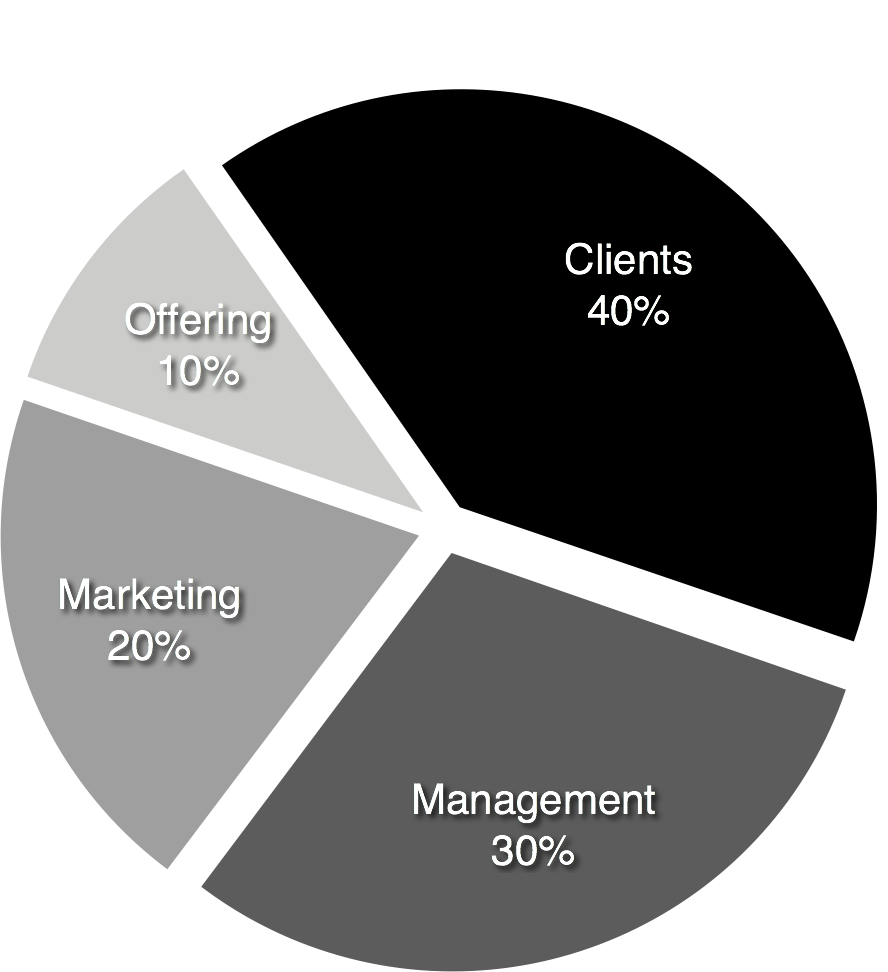
- Clients: 40%
- Management: 30%
- Marketing: 20%
- Offering: 10%
Only 10% of your time on your offering!
That surprises most people. Most of us spend our days polishing the thing we sell. But the offering is the least unique part of your business. The clients are where the business lives.
Spend your time where your clients are.
Create huge value
Long before gold and money, value ruled trade. What is value? Value is how much someone wants something. Economists call it demand.
Set your price as a small fraction of the value you create.
Let’s say you charge $100 an hour. I have a service that saves you ten hours a month. That’s $1,000 of your time, every month.
- If I charge $1,000 a month, you might buy it. You might not.
- If I charge $100 a month, you’d hardly hesitate.
- If I charge $10 a month, one hundredth of the value, it’s an easy yes.
The smaller your price is next to the value you create, the easier the sale.
The best value of all is something everybody needs.
Price a slice of the value.
Think About It
Track your time for one week. At the end of the week, sort each hour into one of the four pillars. How close are you to 40, 30, 20 and 10? Then do the value sum for your main service. What is it worth to your client? What fraction of that do you charge?
Chapter 8: Your First Catch
You now have a full tackle box. Five ways to fish. A database. Handwritten notes. A habit of measuring. Seven ways to get a yes. A checklist. Four pillars and a way to price.
Don’t try to use it all at once. That’s a schedule, and you know how schedules end.
Use a checklist instead. Put one thing at the top.
Here’s the one thing to do this week. Open a spreadsheet and list twenty people you know. Pick three of them. Write each one a short handwritten note. Thank them for something specific. Put the notes in the mail.
Then count. How many replied? How many sent someone your way? Write the number down.
That’s the whole method in small. You gathered by hand. You built your database. You connected personally. You measured.
Next week, do it again. Then pick the next item on your list.
Start small. Measure. Repeat.